GAITF.COM × GAITF.LAN: Connecting Cloud Accessibility with Campus Infrastructure
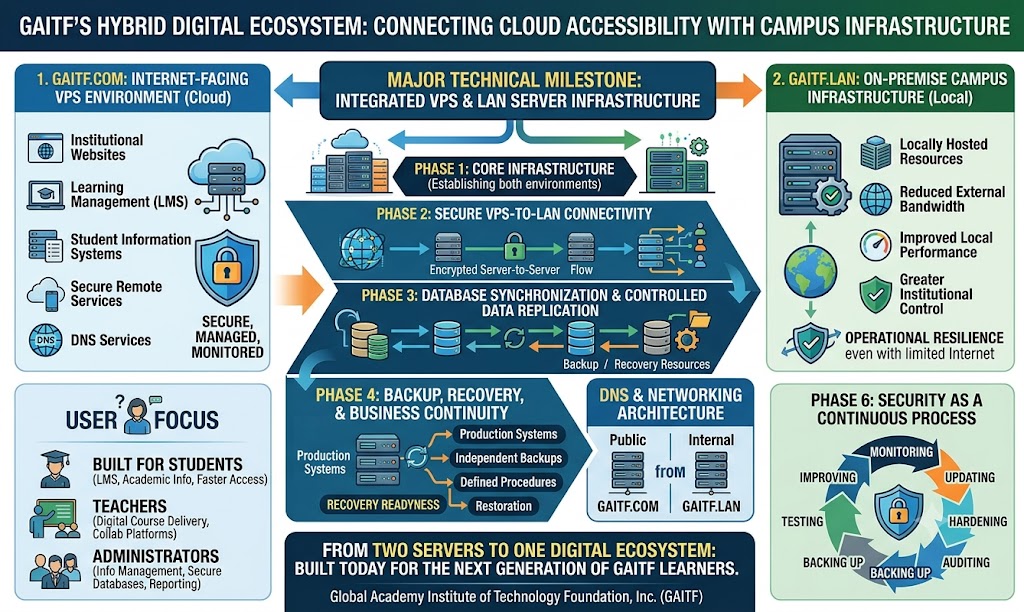
Global Academy Institute of Technology Foundation, Inc. (GAITF) marks a significant technical milestone in its continuing digital transformation with the development, configuration, and integration of its VPS-based GAITF.COM infrastructure and on-premise GAITF.LAN server environment.
This initiative represents more than the deployment of additional servers. It establishes the foundation of a hybrid digital infrastructure designed to bring together Internet-accessible services, on-campus computing resources, secure server-to-server connectivity, data synchronization, backup and recovery capabilities, and centralized systems administration.
At the core of the initiative is a simple but important objective:
Build a secure, resilient, scalable, and institutionally managed digital ecosystem capable of supporting GAITF’s students, teachers, administrators, personnel, and stakeholders.
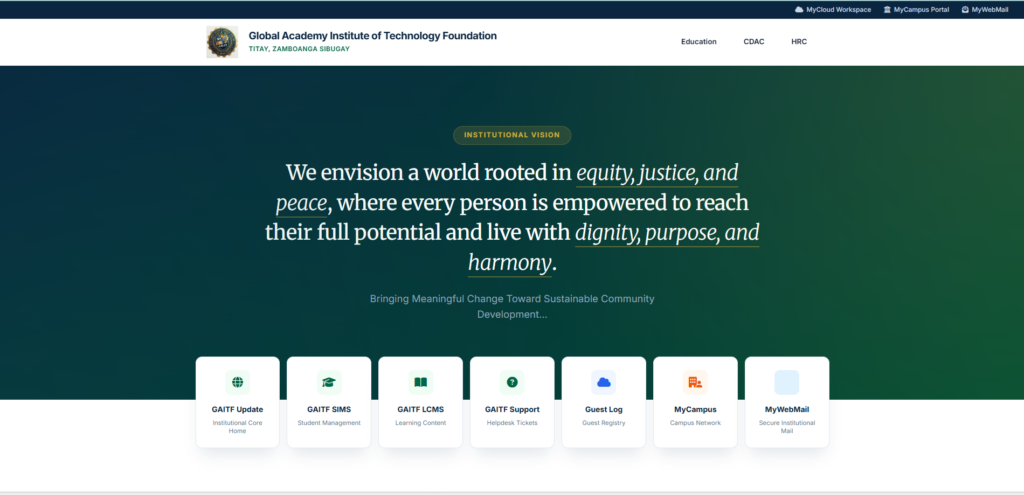
A New Chapter in GAITF’s Digital Infrastructure
As educational institutions become increasingly dependent on digital platforms, the infrastructure operating behind those platforms becomes just as important as the applications themselves.
Learning management systems, student information systems, institutional websites, databases, administrative applications, communication platforms, and other digital services require a reliable technological foundation.
GAITF is addressing this requirement through two complementary server environments:
GAITF.COM — VPS / Internet-Facing Infrastructure
and
GAITF.LAN — On-Premise / Campus Infrastructure
Rather than operating these environments simply as isolated servers, GAITF is developing an architecture in which cloud-based and local computing resources can complement one another.
The result is the foundation of a hybrid infrastructure designed around accessibility, local performance, security, data protection, operational continuity, and future scalability.
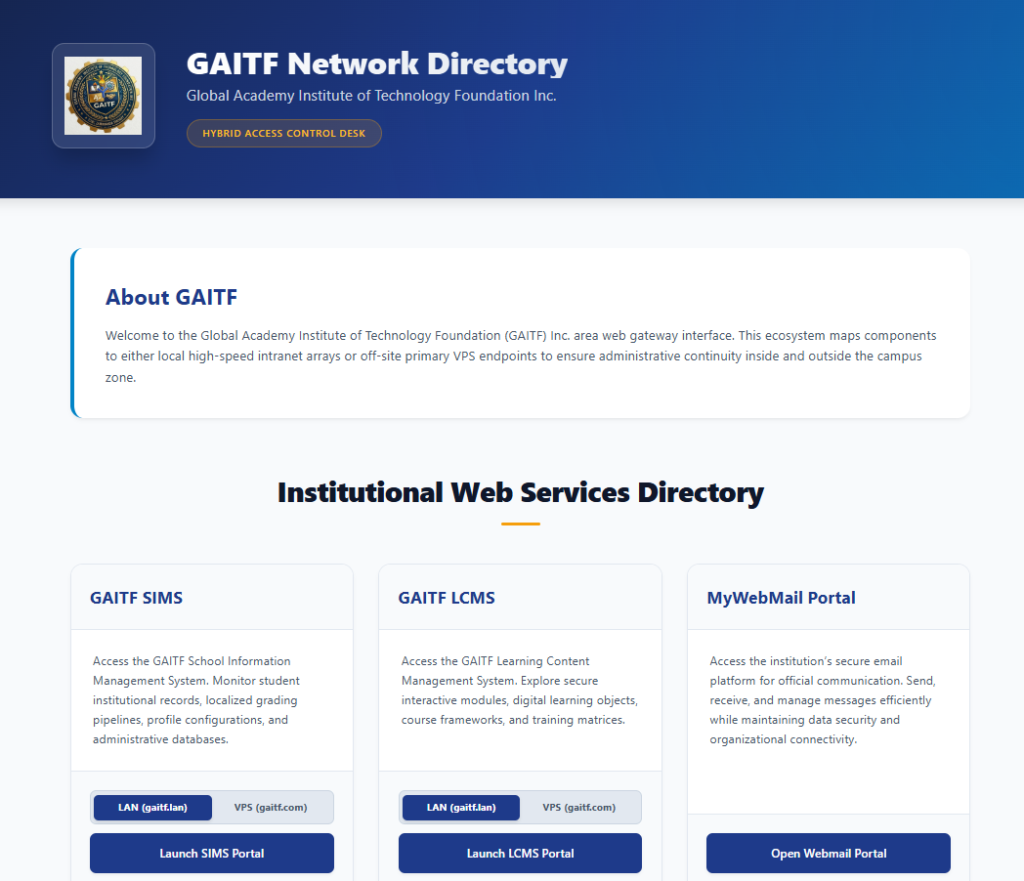
PHASE 1 — ESTABLISHING THE CORE SERVER INFRASTRUCTURE
GAITF.COM: The Internet-Facing VPS Environment
GAITF.COM serves as a central component of GAITF’s Internet-accessible digital infrastructure.
Hosted within a Virtual Private Server environment, it provides the computing foundation required to deliver authorized institutional systems and services over the Internet.
The VPS environment is designed to support services such as:
- Institutional websites and web applications
- Learning and academic platforms
- Student and administrative information systems
- Database-driven applications
- Secure remote services
- Domain and DNS-related services
- Online communication and institutional resources
Because these resources are Internet-facing, the infrastructure requires careful management of server security, authentication, network services, application availability, databases, backups, logging, and access controls.
The goal is not simply to make systems available online.
The goal is to make them available through an infrastructure that can be managed, secured, monitored, maintained, and continuously improved.

GAITF.LAN: Bringing Computing Infrastructure Inside the Campus
Complementing the VPS environment is GAITF.LAN — GAITF’s dedicated on-premise Local Area Network server infrastructure.
GAITF.LAN is designed to provide locally hosted computing resources and institutional services directly within the campus network.
This architecture brings selected services physically closer to students, teachers, administrators, and other authorized users.
For systems operating locally, this can provide several important advantages.
Local network traffic does not always need to travel through the public Internet before reaching an institutional resource. Depending on the application and configuration, this can improve response time, reduce unnecessary external bandwidth consumption, and provide greater institutional control over locally hosted resources.
The LAN infrastructure also creates opportunities for GAITF to develop services that can continue operating locally even when external Internet connectivity is limited, provided those services do not depend on unavailable external resources.
This makes GAITF.LAN an important component of the institution’s long-term strategy for local performance, service availability, infrastructure control, and operational resilience.
PHASE 2 — SECURE VPS-TO-LAN CONNECTIVITY
One of the most important technical components of the architecture is establishing secure communication between the VPS and on-premise environments.
Conceptually, the infrastructure follows this model:
INTERNET / USERS
↓
GAITF.COM
VPS / Public-Facing Infrastructure
↓
Encrypted & Authenticated Server-to-Server Connectivity
↓
GAITF.LAN
On-Premise / Campus Infrastructure
↓
Local Systems, Databases, Applications & Backup Resources
Secure remote administration and server-to-server communication can be implemented using technologies such as SSH with cryptographic key-based authentication, together with appropriate firewall rules, access controls, and network security policies.
This allows authorized infrastructure administrators to manage systems securely while reducing dependence on less secure authentication methods.
The principle behind the architecture is:
Public services remain accessible where required. Internal services remain controlled. Communication between infrastructure components is authenticated and protected.
PHASE 3 — DATABASE SYNCHRONIZATION AND CONTROLLED DATA REPLICATION
Modern institutional systems depend heavily on data.
Student records, learning platforms, administrative systems, websites, application databases, and other digital services continuously generate information that must be protected and managed responsibly.
For this reason, GAITF’s infrastructure development includes planning and implementation of controlled database synchronization and replication strategies between appropriate VPS-hosted systems and the local infrastructure.
A simplified architecture may be represented as:

GAITF.COM — Primary Online Services
↓
Controlled Data Replication / Synchronization
↓
GAITF.LAN — Local Data Environment
↓
Backup / Recovery Resources
Where appropriate, replication can allow selected data changes from an authorized primary environment to be synchronized with a secondary environment.
This architecture can contribute to:
Data Availability — maintaining authorized copies of important institutional data in designated environments.
Operational Continuity — providing infrastructure options when one environment becomes temporarily unavailable.
Recovery Readiness — helping maintain more recent data copies as part of a broader recovery strategy.
Institutional Data Control — allowing GAITF to maintain managed infrastructure for critical institutional information.
However, replication alone is not a backup.
A properly engineered infrastructure requires replication to be complemented by independent backups, retention policies, integrity verification, access controls, and tested recovery procedures.
This distinction is an important part of GAITF’s infrastructure strategy.
PHASE 4 — BACKUP, RECOVERY AND BUSINESS CONTINUITY
Infrastructure resilience is not measured only by how well systems operate when everything is working.
It is also measured by how effectively an institution can respond when something goes wrong.
Possible disruptions may include:
- Hardware failure
- Storage failure
- Database corruption
- Software or configuration errors
- Network interruptions
- Internet service outages
- Cybersecurity incidents
- Accidental deletion or modification of data
- Application failures
- Unexpected infrastructure downtime
For this reason, GAITF’s architecture is being developed with backup, recovery, redundancy, and business continuity as core considerations.
The long-term objective is to establish multiple layers of protection.
Production Systems
↓
Controlled Synchronization / Replication where appropriate
↓
Independent Backup Copies
↓
Defined Retention and Recovery Procedures
↓
Restoration and Disaster Recovery Capability
A backup has value only when it can be restored successfully.
Therefore, effective disaster recovery involves not only creating backup files but also validating their integrity, protecting them from unauthorized access, maintaining appropriate retention periods, and periodically testing restoration procedures.
This approach helps move the institution from simply asking:
“Do we have a backup?”
to the more important question:
“Can we reliably recover our systems and data when we need them?”
PHASE 5 — DNS, NETWORKING AND SERVICE ARCHITECTURE
Behind every accessible digital service is a network architecture responsible for directing users and systems to the correct destination.
GAITF’s hybrid environment involves both public and internal infrastructure.
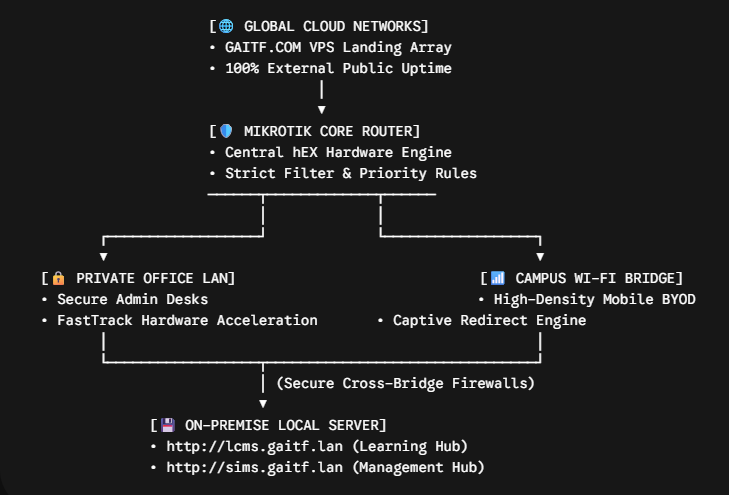
Public Environment
GAITF.COM
This environment provides domain-based access to authorized Internet-facing institutional systems and services.
Internal Environment
GAITF.LAN
This environment provides a structured namespace and network environment for systems operating within the institutional LAN.
The separation between public and internal infrastructure provides GAITF with greater flexibility in determining:
- Which services should be publicly accessible
- Which services should remain internal
- How internal systems resolve network resources
- How servers communicate securely
- How applications and databases are segmented
- How future infrastructure can be expanded
This creates a clearer architectural boundary between the public Internet environment and the private institutional network.
PHASE 6 — SECURITY AS A CONTINUOUS PROCESS
Connecting servers creates capability.
Securing those connections creates trust.
Cybersecurity is therefore a fundamental component of the GAITF.COM × GAITF.LAN architecture.
The infrastructure is being developed around multiple security principles, including:
- Secure administrative access
- Cryptographic SSH key authentication
- Principle of least privilege
- Controlled firewall policies
- Restricted network exposure
- Server and application hardening
- Database access controls
- Security logging and monitoring
- Regular software and security updates
- Backup protection
- DNS and domain security
- Web application security
- Authentication and authorization controls
- Incident response and recovery readiness
No infrastructure should be considered permanently “secure” after a single configuration.
Security is an ongoing process involving:
MONITORING.
UPDATING.
HARDENING.
AUDITING.
BACKING UP.
TESTING.
IMPROVING.
As technologies and threats evolve, the infrastructure must evolve with them.
FROM TWO SERVERS TO ONE DIGITAL ECOSYSTEM
The real significance of this milestone is not simply that GAITF operates a VPS server and a LAN server.
The significance lies in how these environments are being engineered to work as components of a broader institutional architecture.
GAITF.COM provides Internet-facing accessibility.
GAITF.LAN provides locally managed campus infrastructure.
Secure connectivity establishes protected communication between environments.
Controlled replication and synchronization can help maintain authorized data across designated systems.
Independent backups protect against data loss.
Recovery procedures prepare the institution for unexpected failures.
Monitoring and security controls help protect infrastructure and services.
Together, these components form the foundation of a more resilient digital ecosystem.
GAITF.COM
The Cloud-Facing Infrastructure
↕
SECURE CONNECTIVITY
↕
GAITF.LAN
The Campus Infrastructure
↕
DATA • APPLICATIONS • BACKUPS • DIGITAL SERVICES
This is the architecture behind GAITF’s continuing digital transformation.
BUILT FOR STUDENTS
For students, infrastructure should ultimately translate into better access to technology-enabled education.
A stronger digital foundation can support:
- Learning management and digital learning resources
- Student information and academic services
- Campus-based digital applications
- Faster access to locally hosted resources
- More reliable technology-enabled learning environments
- Future digital services and innovations
Students may never see the servers, databases, network configurations, or background processes operating behind these systems.
But every successful login, every loaded learning resource, and every accessible digital service depends on infrastructure working behind the scenes.
BUILT FOR TEACHERS
For teachers, reliable infrastructure provides the foundation for modern teaching and learning.
It can support digital course delivery, learning resources, academic information systems, collaboration platforms, instructional applications, and other technology-enabled services.
The objective is to create an environment where technology becomes an enabler of instruction rather than an obstacle to it.
BUILT FOR ADMINISTRATORS AND PERSONNEL
Institutional operations increasingly depend on reliable information systems.
A well-designed server and network architecture can support:
- Centralized information management
- Administrative applications
- Secure institutional databases
- Digital records and workflows
- Internal communication systems
- Reporting and data-driven decision-making
- Backup and recovery processes
- Controlled access to institutional resources
The stronger the underlying infrastructure becomes, the greater the institution’s capacity to develop and integrate future digital services.
BUILT FOR STAKEHOLDERS
For parents, partners, alumni, government agencies, industry partners, and other stakeholders, digital infrastructure contributes to a more connected and responsive institution.
Reliable technology helps GAITF communicate, collaborate, deliver services, manage information, and build partnerships beyond the boundaries of the physical campus.
Digital transformation is therefore not only an internal IT initiative.
It is an institutional capability.
THE TECHNOLOGY USERS DO NOT SEE
When someone opens a website, logs into a learning platform, accesses a student system, or uses an online service, the experience may appear simple.
Behind that simplicity is a complex technological ecosystem.
There are:
SERVERS.
NETWORKS.
DATABASES.
DNS.
FIREWALLS.
AUTHENTICATION SYSTEMS.
ENCRYPTION.
BACKUPS.
LOGS.
MONITORING.
APPLICATIONS.
SECURITY POLICIES.
CONFIGURATION FILES.
And countless technical processes working together behind the scenes.
Building digital infrastructure means engineering all of these components so they can operate as one dependable ecosystem.
MORE THAN DEPLOYING SERVERS — BUILDING INSTITUTIONAL CAPABILITY
This milestone represents something larger than installing operating systems, configuring network services, or connecting machines.
It represents the continuing development of GAITF’s own institutional capacity to:
DESIGN technology.
BUILD infrastructure.
DEPLOY systems.
SECURE services.
MANAGE data.
MONITOR operations.
RECOVER from failures.
AND CONTINUOUSLY INNOVATE.
Technological independence does not mean operating without external technologies or partners.
It means developing the institutional knowledge and capability to understand, manage, integrate, secure, and improve the technologies upon which the organization depends.
That capability is itself an investment in the future.
A FOUNDATION FOR WHAT COMES NEXT
The GAITF.COM × GAITF.LAN infrastructure is not an endpoint.
It is a foundation.
As the architecture continues to mature, it can support further development in areas such as:
- Enhanced server-to-server integration
- Automated and controlled data synchronization
- Improved backup automation and retention
- Disaster recovery testing
- Infrastructure monitoring and alerting
- Centralized logging
- Enhanced cybersecurity controls
- Network segmentation
- High-availability strategies
- Improved identity and access management
- Secure remote connectivity
- Expanded locally hosted services
- Automation of infrastructure management
- Scalable computing and storage resources
Each phase contributes to one long-term objective:
A secure, resilient, scalable, and future-ready digital infrastructure for GAITF.
CLOUD × CAMPUS — ONE CONNECTED GAITF
This technical milestone reflects GAITF’s continuing commitment to innovation and responsible digital transformation.
We are building an infrastructure where cloud accessibility and campus computing can complement each other.
Where online services connect with locally managed resources.
Where data is not only stored, but protected.
Where systems are not only deployed, but monitored and maintained.
Where backups are not only created, but designed with recovery in mind.
Where cybersecurity is not treated as a one-time configuration, but as a continuous institutional responsibility.
And where technology is built around the people it ultimately serves.
Our students.
Our teachers.
Our administrators and personnel.
Our partners.
Our stakeholders.
Our institution.
GAITF.COM × GAITF.LAN
CLOUD × CAMPUS
PUBLIC ACCESS × LOCAL PERFORMANCE
CONNECTIVITY × SECURITY
DATA × RESILIENCE
INNOVATION × EDUCATION
ONE CONNECTED DIGITAL ECOSYSTEM.
Technology Empowering Education.
Infrastructure Enabling Innovation.
Security Protecting Our Digital Future.
Building Today the Digital Foundation for the Next Generation of GAITF Learners.
— Global Academy Institute of Technology Foundation, Inc. (GAITF)
Leave a Reply